

Just Added 8 More Kids “Magazine Style” Workbooks
These days it’s really important to get a great mix between the software (...
We’re up to about 5 minutes to review all the previous material. Go as quickly as you can but let’s not miss any out!
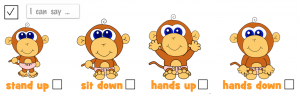
1. 

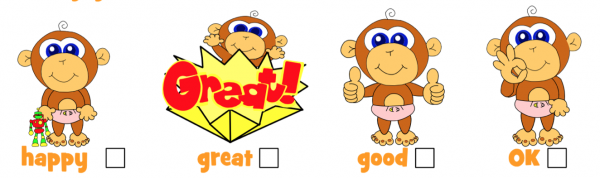
Play 2. Rock, Paper, Scissors ask 3. What’s your name? + My name is ….. & Nice to meet you, 4. How are you? + several of the answers
5. 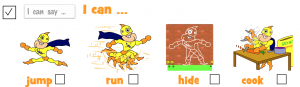

6. Left, right, forward & back. Plus the Left & Right song.
Phew. That’s a lot. But you can see how by quickly reviewing everything in each lesson we are building up this huge library of English the students can use and recall almost instantly.
That’s how we build fluency. It’s very impressive. 🙂
No grammar explanations, just point at people as you teach each line using the “Words” section of the software and the song from the Teacher’s Set.
Doing it this way works for any age from 3 to 93.
Ninja Tip: Be sure to ask the students what they’ think the meaning of each sentence is. Not the words, the sentence. More here…
And here is the song in action:
Put the “words 2” section of the How are you? software on the board:
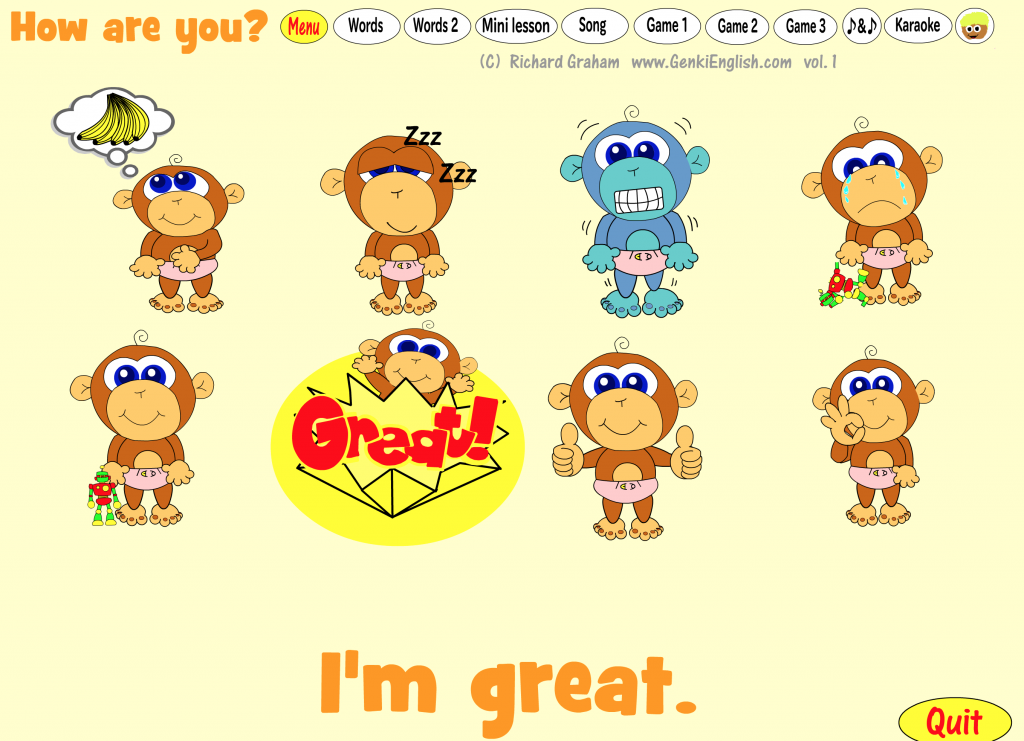
Let’s start simple and build up:
1. Put the students into pairs.
2. The first person in the pair says “I am …” plus one of the words from the screen e.g. I am cold.
3. The other person in the pair makes it into a “you” sentence, e.g. “You are cold”
4. Repeat from step 2.
5. But if the first person says “I am hungry!” then both players have to race and touch the nearest wall.
6. If the hungry person catches the other student they eat them!
7. If the other student reaches the wall first, they are safe!
8. They repeat with the other person asking questions.
You’ll see this is a lot of fun! Play it for around 4 or 5 minutes or until the students find the English really easy.
Then move on to adding he & she.
Get them to make groups of 3 (mingle is great for this).
Now one person says “I am…” and the other two say “He is …” or “She is…”
And finally, we and they.
Ninja Tip: This is quite a lot to do in one lesson. Keep it fun. Keep your cool. And enjoy the results!
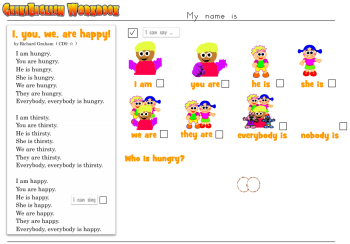
I am, you are, he is happy
by Richard Graham
I am hungry.
I am hungry.
You are hungry.
You are hungry.
He is hungry.
He is hungry.
She is hungry.
She is hungry.
We are hungry.
We are hungry.
They are hungry.
They are hungry.
Everybody is hungry.
I am thirsty.
I am thirsty.
You are thirsty.
You are thirsty.
He is thirsty.
He is thirsty.
She is thirsty.
She is thirsty.
We are thirsty.
We are thirsty.
They are thirsty.
They are thirsty.
Everybody is thirsty.
I am happy.
I am happy.
You are happy.
You are happy.
He is happy.
He is happy.
She is happy.
She is happy.
We are happy.
We are happy.
They are happy.
They are happy.
Everybody is happy.
Everybody is happy.
If you have the Teacher’s Set you can also download these extra printables
More A4 Flashcards
(What’s this?)
Mini Cards
(What’s this?)
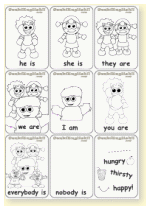
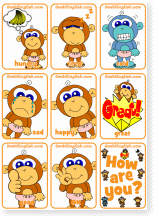
Printable
Lesson Plan
(What’s this?)
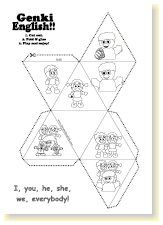
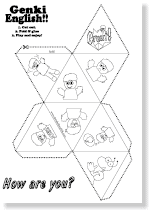
Dice Game
(What’s this?)
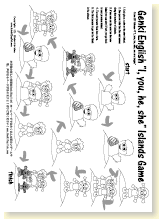
Islands Game
(What’s this?)
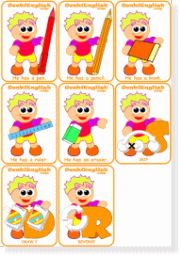
One Left Card Game
(What’s this?)
If you’re coming back to review this theme later, you can use this card game to practice the pronouns with “have/has” and the stationery theme.
Readers’ Comments
I’ve been using this song in my classes lately and I love it. It has really helped with the personal pronouns and verbs that I’ve been teaching lately. It reminds me of something from my childhood but I can’t quite pin down what. Keep up the good work. Rosebud.
I’ve used the song now with my 2 classes of sixth graders and it is a huge hit!! They were singing the song quietly throughout the whole lesson! It was still in their heads this morning. SUPER!
I place the students in a big circle and on the inside are myself, a student in front of me and a boy and a girl on either side. You sing to the appropriate person and those in the middle join hands for “we” then we point to those in the outer circle “they” and for “everyone”, everyone joins hands and sings. – Carol
Great song. I use Japanese sign language. The thumb for ‘he’ the pinky for ‘she’ both the pinky and thumb on one hand for ‘they’. For ‘we’ I do an sweeping motion toward and across the body with an open hand. Whenever I use the words in any sentence or question I try to do the gesture.
He and She are not ‘obvious’ signs so before I teach the signs I write the words ‘he’ in blue and ‘she’ in pink on the blackboard. Then I use pix of famous people by saying ‘He’ is Ichiro. ‘She’ is Sayaka Aoki. Then I ask students ‘he’ or ‘she? by moving the picture to both words. They catch on really quick. I usually try to end with ‘Ikko’ or ‘Mikawa Kenji’ (Japanese male celebrities who wear dresses and take on a woman persona) for a laugh. Then I move on to the students who become very aware of the meaning and difference of the two words. – Gumby
You must be logged in to post a comment.
Wow, I like this new set up!
It’s more organized and things are easier to find as they’re clearly put into different sections! Love it!
The video here also made it all more impressive. Hearing you say all the stuff they have learned at this point is like “WOW!” One doesn’t see it so clearly until you mention it here!
Another thing I like is how you have a very nicely organized section for the VIP extras. Makes it very easy to organize on one’s computer.
I love it! What else can I say? It’s clean, sleek, organized.
Thank you, Richard!
Thank you Carolyn, much appreciated!
i love this!!!! all the lessons are excellet!!!
I realised how important to attract the children by your games and ideas and how getting control from the first minute. Also , making them using their energy through classrooom activity…
I like it , all your lessons ,games and songs are Fantastic
Can’t wait for your new songs and games to come out
Thanks !
WOW, so exited and amazing ,, you are absolutely doing great job to make teachers self confident while teaching .. !!!!
Ish
The lessons are very organised and child centered ,what all I can say is Genki English is really genki awesome!
I love the energy and structure that Genki English brings.
Thank you Richard!!
Dearest Richard,
My oh my! I can hardly contain my energies right now. This teaching method buzzes me so much that I am no longer a burnt out slogger on a Friday afternoon. I am hopping around the garden and running after my own children with a wonderful positive glow in me.
This morning I put two groups together because of Easter Thursday and your methods gave me great confidence which the children picked up on and the lesson was a dream. The kids are speaking so much alone already. I feel like a super hero. Thanks to you!
The Pronouns Scavenger Hunt.
Get them Genki in the classroom, while teaching them to recognize the nouns that specific pronouns may replace! Prepare for this activity by hiding the (Me, him, her and you etc…) pictures and nouns around the classroom. For each round, let the students look for those that match the pronoun you will mention. For example, if you say “he” for a certain round, they must only gather pictures of males and nouns that can be replaced by this particular pronoun, such as “brother” and “waiter”. You may ask them to stick these pictures and nouns on the board under the corresponding pronoun.
You may want to do this activity by groups too! Assign one pronoun for each group, so that every group will be looking for and collecting different pictures and nouns.
Dear Richard,
when and how would you advise to implement questions “Is she?”, “Is he?”, “Are we?”, “Are they?” Thank you!
Good question Elen! It depends on the level of the class and your experience. If both are good then you can certainly introduce these words right here in this lesson!
Dear Richard
You’re so energetic!!!I’m wondering how you build up your energy?
Lubov
Here you go Lubov!
http://genkienglish.net/teaching/where-do-i-get-all-my-energy/
Hey Richard.
Id like to say thanks for creating the Genki English teachers set
its made teaching a blast and learning so much fun for the
students. I`m new to the teaching game I started a school
in japan six weeks ago, we have a four year old girl in our class
and her mother messaged my wife to compliment us and
to tell us she is already using English at home and she actually
corrects her mums English pronunciation, that’s what makes
this job so rewarding a simple compliment. Just thought you
would like some positive feed back. Thanks again
Is there a card for “it” somewhere?
Hi Rich, good question, I usually leave teaching “it” for the other lessons e.g. What’s the weather like? with It’s sunny etc. or the Fruit Market with “it’s a ….”
If we did do an “it” card, how would we illustrate it?
very good the song with the pronouns….I will do it in my scholl….thanks richard I continue to learning with you I appreciate it……..
marcela
Hi,
This lesson is awesome and very beneficial. I love it!
With the game:
I was wondering with He is… or She is…
With Kindergarden kids (age 4-5) would it be OK if we did it first in a big group (all) and then split(grps. 3-4)? Because I´m having some trouble making sure they are actually asking each other the questions.
Or do you recommend something else?
Thanks!
Oliver
Hi Oliver,
Yep, it’s usually best to demo it with everyone watching first and then when (sometimes “if”) the kids are ready you can split them up into smaller groups.
Also check out the discipline pages to nip the trouble making in the bud for next time 🙂
https://genkienglish.net/teaching/discipline/
Thanks a lot!
I couldn’t figure out how to use the origami thing. If anyone could help me out it would be great!
And the stationary mini cards too. Could anyone explain their usage for me please? Maybe you even have a experience of using them in the classroom – I would be most grateful if you share it!
Loved it a lot. I’m happy after watching the videos. Lesson plans are great