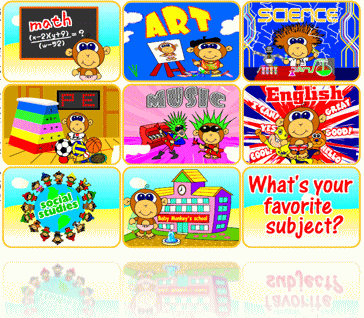
| What's your favorite subject? (US Mix) ============ =========== by Richard Graham What's your favorite subject? What's your favorite subject? What's your favorite subject? What's your favorite subject? I like math (I like math) I like art. (I like art.) I like science (I like science) I like P.E. ( I like P.E.) (Repeat Chorus) I like music (I like music) I like English (I like English) Social Studies (Social Studies) I like ... (add in the kids' native language here) What's your favourite subject? (UK Mix) ============ =========== by Richard Graham What's your favourite subject? What's your favourite subject? What's your favourite subject? What's your favourite subject? I like maths (I like maths) I like art. (I like art.) I like science (I like science) I like P.E. ( I like P.E.) (Repeat Chorus) I like music (I like music) I like English (I like English) Social Studies (Social Studies) I like ... (add in the kids' native language here) In Baby Monkey's School In Baby Monkey's school In Baby Monkey's school In Baby Monkey's school In Baby Monkey's school We have math on Monday. We have art on Tuesday We have science on Wednesday We have P.E. on Thursday (Repeat Chorus) We have music on Friday We have English on Saturday We have social studies on Sunday And today we have ….. |
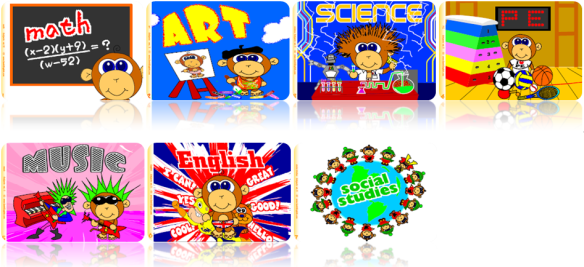
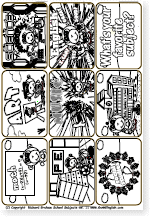
Or use the flashcards below:
Plus there are mini cards:
+ Dominoes
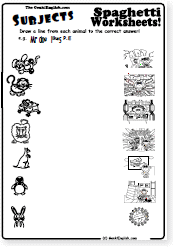
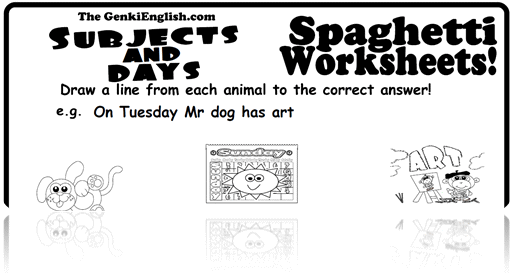
(What's this?)
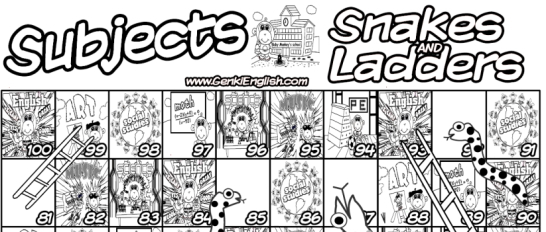
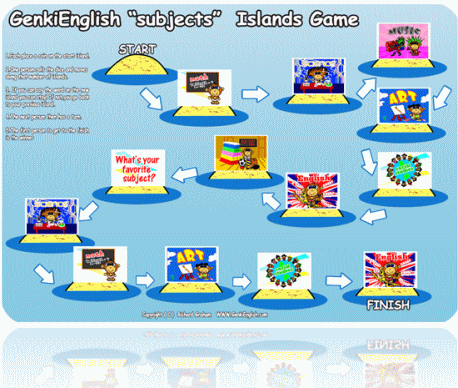
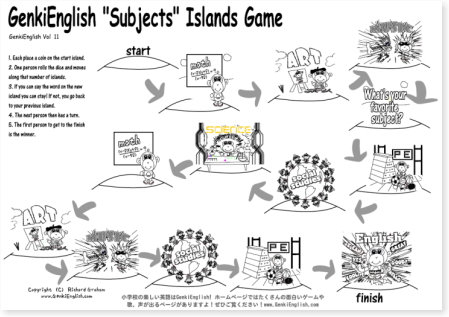
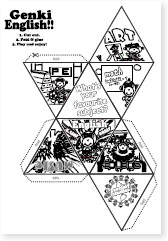
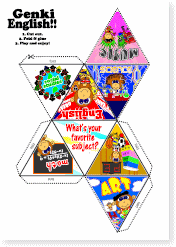
And the dice game (What's this?)
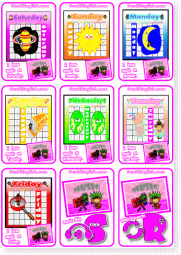

1. Put the flashcards on the floor.
2. If you have more than 7 students then print out more sets so each child
has a card.
3. Play the song and the kids dance round in a circle.
4. When you stop the music each child has to step on a flashcard.
5. Go round the class so everyone says the sentence (e.g. "I like
..." or "I have ...") with their flashcard.
6. Now, take away one or two cards!
7. Repeat from 3.
8. One or two children won't have cards, so they now join you asking the
other kids the question.
9. Keep going till one child is the winner!
You can also play this with mini cards dancing round a table top and each
kid has to slap one card each when the music stops!
Catch the Thief Game
by Atley Jonas
Kids LOVE chase games. I remember years ago, long before anyone even invented
the term "politically correct" all of us neighborhood kids played
"Cowboys & Indians" or "cops & robbers." Somehow
I always ended up as a robber or an Indian, but that's a story for another
time. I was even a little surprised that when I came to Japan and started
teaching junior high school, we all played "cops & robbers"
during gym class.
Well, this English game is inspired in part by this – but you don't need
a large space or gymnasium to play it, even though it does often result
in kids tearing around the room chasing each other down, and other kids
hiding under desks or in the corner broom closet. It's all in good fun,
but with some classes they can get a little rowdy, so be prepared to use
your good discretion as a teacher.
Storyline:

Some evil fiend has stolen the kocho sensei (principal's) electronic dictionary (denshi jishou)!
*Gasp* It's up to the detectives to find the guilty ones and throw them in jail!
Target: For the purpose of explanation, I will use the target question, "What
subject do you like?"
Target vocabulary words include, "English, Japanese, P.E., social
studies, art, music, math, and science."
This could, of course be adapted to anything that utilizes a question/answer
pattern where you can separate out two or more distinct answers, (e.g.
"Do you (like/have/want/etc) ______ ? Yes I do / No I don't" or "What ______ do you (like/have/want/etc)? or "What's your favourite _____ ? )
Materials: Technically, you could play this game using absolutely nothing, but to
make it most enjoyable and easy to understand, I recommend: 1 set of A4-sized
vocabulary flashcards , and 1 set of corresponding mini-cards ( see above!).
For the small-class version of the game you will also need a stopwatch
and a noisemaker of some kind (like a bell, a rattle or a whistle).



1. Put up the large vocabulary flashcards on the board. Then, assign each student a number from 1 to 8. Explain to the students that this number corresponds to one of the vocabulary words.
For example,
1=English,
2=Japanese,
3=P.E.,
4=social studies,
5=art,
6=music,
7=math,
8=science.
(An alternate way to assign roles would be to hand out corresponding mini-cards
to each student). Tell them that for the duration of the game, this is
now their new favorite subject. (Watch the kids who hate math moan &
groan when they find out that's the one they're stuck with).
2. Choose 4 to 8 students from the class who will be detectives. For the purposes of scoring, I usually choose these according to pre-established classroom groups (like lunch groups). In each group, there is usually already a pre-determined group leader (hancho-san in Japanese) which can save a lot of time when choosing who's going to be a detective. Usually, in most classrooms, there are 6 lunch groups, each with 6 to 7 students, a group leader and assistant group leader (fuku-hancho-san).
3. Call up (6) detectives (1 from each group) to the front of the classroom.
4. Explain to the class that these people are the new detectives who have
been assigned to find the gang of thieves (who stole kocho sensei's dictionary).
This gang of thieves has the same favorite subject, namely one of the eight
subjects they've learned. To each detective, hand out a "suspect profile
card" (a mini-card with one of the eight subjects on it). Their task
is to go around the class full of suspects and each find 2 of the thieves
(indicated by the subject on their mini-card) by asking them, "What
subject do you like?"
5. The detective then goes around the class asking everyone, "What
subject do you like?" The answering student says, "I like (subject)."
(Answering with the subject that corresponds with the number he was assigned).
6. If anyone answers, "I like __________" and that subject matches
the card that the detective is holding, he is a thief and must be taken
to jail. (In my class, I make the "jail" the area around the
front of the classroom, next to the blackboard.
7. When a detective catches a thief, he must grab him (by the hand or arm or latch onto their clothing). When he catches both thieves, he must bring them back to the teacher (the judge). The two fastest detectives then each get rewarded 1 point (for their group).
8. Repeat with different detectives. Again, give each new detective a random
mini-card which will result in different students being the "guilty"
subjects each time.
9. For added fun and chaos, have all the students "mingle" around
the classroom during game play.
TIPS: When you give the mini-cards to the detectives, tell them not to
show it to anyone because this is what makes the game really fun, as no
student actually knows whether they will be "guilty" or not until
they answer the detective's question. (Yeah, I know that it doesn't make
much sense that a thief wouldn't know whether or not he's guilty until
a detective asks him, but in this case, for the sake of the flow of the
game and by pure trial and error, working out the bugs with many different
classes, I had to sacrifice logic a little. Sorry. Besides, the kids don't
seem to catch onto this little nuance).
Also, point out that ANYONE in the class is fair game for interrogation,
including you, the Japanese teacher (if present) or even another detective!
(Can you say: "police corruption"?)
This works similar to the large class variation, except there is only 1 detective (or 2 if you want to play the game head-to-head). You will also need a small bell, drum or other noisemaker and a stopwatch.
1. The detective(s) leave(s) the room.
2. Hand out mini-cards to the remaining students, giving kids 2 cards if
necessary, but there will only be 1 "guilty" card.
3. Before the detective returns to class, explain to the detective that
the guilty party's favorite subject is (choose a subject at random).
4. The detective then returns to class, and has 1 minute to find the guilty
party by asking, "What subject do you like?"
5. The students "mingle" while the detective is going around
asking questions.
6. Now here's the real kicker: Whenever the teacher rings the bell (or makes noise with the noisemaker) all the students, quickly, without saying a word and without showing their cards to anyone, trade cards.
7. If the detective can find the thief in the allotted time, he/she wins!
8. If playing head-to-head (with two teams), use 2 detectives and the fastest of the two students wins a point for their team.
NOTE: If kids are walking around with two cards, make sure to remind the detective to ask twice.
This game can be played either individually as a contest to see who can score the fastest time, where you use a stopwatch to record how long each detective takes to find the thief and then record the students' times on the blackboard, OR play the game with 2 teams, where each successful detective scores 1 point for his/her team.
Another interesting thing I found out in Japan, is that kids here love
card games. Whether it's "Old Maid" (Babanuki) among the elementary
school kids or "Dauto" with the junior high and high school crowd,
you can do a lot with a deck of cards – especially if it's a smaller class.
This game is similar to the traditional game of "Crazy Eights."
You shouldn't have much trouble explaining the rules because they are almost
perfectly analogous to the rules of "Uno" which 99% of all Japanese
kids know well and love to play. What makes this game interesting, however,
is that unlike "Uno" or other traditional card games which can
be successfully played with little to no spoken conversation, (thus losing
their educational benefit), in order to play (and win) this game, the students
are compelled to speak in English... Often. – In fact, you can't win unless
you do!

Materials: 1 standard (52) deck of cards for each group of 6 to 7 students. The game
shouldn't be played with less than 3 or more than 8, for best results.
In this example, the target vocabulary are school subjects, (eg. Math,
science, English, art, music, etc). The target question for students to
practice is, "What subject do you like?" or "What's your
favourite subject?"
Before starting the game, make sure to read and follow the instructions
in the "prep" section.
This is meant to be a review game, so the students should already know the target question and corresponding vocabulary quite well. I also designed it with grades 4 and up in mind. This could easily be played in a Jr. High, High School, or even adult setting. It's also meant for either a small class (2-6 people) or if used in a larger setting, divide up the class into groups of that size.
1. As in a standard "Crazy Eights" game ( Wikipedia explanation) , 5 – 7 cards are dealt to each player.
2. Starting from the dealer's left, play proceeds in a clockwise manner. Students discard the cards in their hand by matching either the suit or the rank of the top, (face-up) card in the discard stack.
3. Eights, of course, are wild and may be played on top of any other card.
4. There are a number of other "special" cards which cause game
play to change according to the rules (see below section). Some result
in a change in game play, but others (and more importantly) result in students
having to speak in English.
5. After a player discards his second-to-last card, he must say a sentence
in English. (The "Uno" rule). For the sake of this example, this
would be: "I like (subject)." Eg. "I like science."
If he forgets to say it, and another student sees a player with only one
card, he/she may beat him to the punch and say the target sentence themselves.
When this happens, the student with only one card must draw four new cards
from the stock deck.
6. The first person to discard all their cards wins and play may continue if desired until all but the last player have discarded all their cards.
PREP
Assign a specific card to each vocabulary word. It's probably best to write
this on the board so students can refer to it at any time.
E.g. (using Kings & Queens)
K♥ = English
K♦ = Japanese
K♠ = art
K♣ = music
Q♥ = math
Q♦ = science
Q♠ = social studies
Q♣ = P.E.
OTHER RULES AND SPECIAL CARD EFFECTS:
2s = Draw two cards from the stock deck. Player then loses his/her turn.
Aces = Change direction of play (clockwise to counterclockwise or vice-versa)
Jokers = Wild (just like 8s) except the player discarding a joker can then choose whichever suite he likes.
Any Special Card = the student discarding that card chooses any other player
and ask them, "What subject do you like?" If the student can
answer correctly (with the subject that corresponds to the face value of
the card), there is no penalty and game play continues as normal. If, however,
he cannot answer correctly, or cannot answer at all (within 5 seconds)
he must draw 4 cards. Play then continues from the person who last discarded.
If a student wishes, he may "stack" cards. In this case, let's
say he plays two Kings in a row, he can ask two different students "What
subject do you like?"
Again, just like with the "last card" rule, if a player sees
that a special card has been discarded but the player who discarded it
didn't ask the target question, he can quickly say the corresponding subject
and force the discarding player to pick up 4 new cards.
Eg. Player ‘A' discards a K♣ but doesn't say anything.
Player ‘B' notices this and exclaims, "MUSIC!"
Player ‘A' draws 4 cards
Play resumes as normal
Variation (simple edition): If asking questions and answering proves to
be too much for the students, then try this instead: when a player discards
a "special card," they just call out the name of another player
who then has to say the corresponding vocabulary word on the card instead
of the whole question/answer routine.
Sign up to get my top tips, games & hints via email! |
 |
|---|
|
|
 Level.